
Last Updated: August 6, 2026
Garage Door Balance Test & Adjustment in Berkeley, CA
When the springs stop carrying the door's weight, the opener carries it instead, and openers die young doing that job. Santos & Sons tests door balance and adjusts spring tension across Berkeley, starting at $89, so the counterbalance does the lifting the way it was designed to.
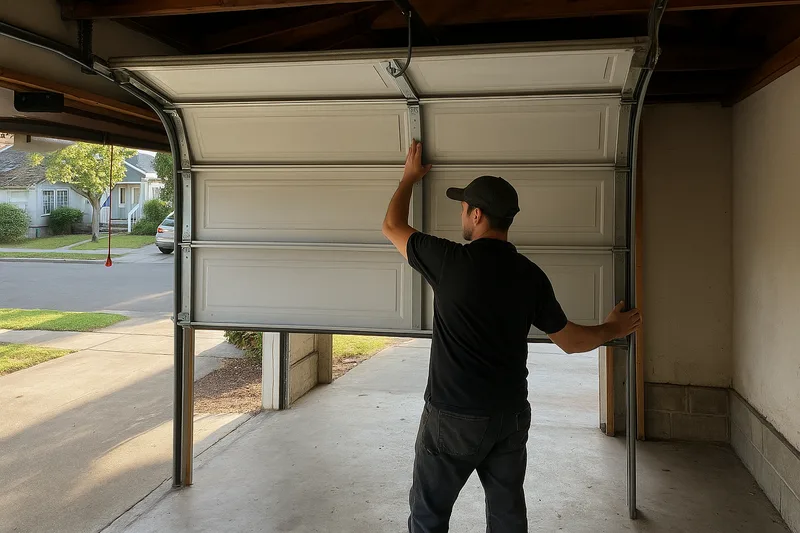
Professional balance testing identifies spring wear before failure
How Much Does a Garage Door Balance Adjustment Cost?
Balance testing and adjustment pricing depends on the scope of work required. Below are current rates for Berkeley and surrounding areas:
| Service | Price Range |
|---|---|
| Balance Test Only | $89 – $109 |
| Balance Test + Spring Adjustment | $109 – $149 |
| Balance + Full Tune-Up | $149 – $199 |
| Emergency Balance Service | $149 – $175 |
All pricing includes the diagnostic test, adjustment labor, and a post-service cycle verification. If we identify additional issues such as a worn spring or frayed cable that requires replacement rather than adjustment, we provide a separate written estimate before proceeding.
How to Test Your Garage Door Balance
Homeowners can perform a basic balance check between professional visits. Follow these steps carefully:
- Close the door completely, resting on the ground with no gaps.
- Pull the red emergency release cord hanging from the opener rail. That disconnects the door from the opener so you can move it by hand.
- Lift the door by its handle or bottom edge to about four feet, the midpoint of the track.
- Let go slowly and step back.
- Read the result. A balanced door hovers at the halfway point. Rising means too much spring tension. Falling means too little, and the springs aren't carrying the door's weight.
Safety warning: testing is the homeowner's half. Adjusting is not. Spring tension work takes winding bars and training, and a torsion spring punishes mistakes. If your door fails this test, call Santos & Sons at (650) 750-7029.
What Causes an Unbalanced Garage Door?
Doors drift out of balance for a handful of reasons:
- Springs aging out. They're rated for 10,000 to 20,000 cycles, and as they fatigue they hold less tension, so the door gets heavier. This is the most common cause of gradual imbalance.
- Temperature swings. Cold stiffens springs and heat loosens them, and the Bay Area's cool mornings and warm afternoons keep working on the calibration.
- A broken spring. When one of two springs snaps, the survivor can't hold the door alone. That's a job for spring replacement, not adjustment.
- A stretched cable, or one that's come partly off its drum. When one cable runs longer than the other, the door lifts crooked and side-loads the tracks.
- Shifted tracks. Impact or loose brackets create resistance at certain points in the travel, which feels like imbalance even when the springs are fine.
- A dented or warped panel changing the door's weight distribution.
- Springs that were never calibrated to the door in the first place. A bad install shows up as imbalance from day one and gets worse.
Dangers of an Unbalanced Door
An unbalanced door costs money quietly, then dangerously:
- The opener motor burns out early. Built to move a balanced door, it instead fights gravity on every cycle, overheating until a $300 to $500 opener that should last 15 years dies in 3 to 5.
- One cable carries more than its share, develops micro-fractures, and snaps without warning. A cable letting go under tension can whip hard enough to cut.
- The door can drop. Disconnected from the opener, a badly unbalanced door with weak springs falls, and 150 to 400 pounds lands on whatever is under it.
- The uneven pull side-loads the tracks until they bend outward, and a bent track eventually means a derailed door and a track repair bill.
- The springs themselves fatigue faster outside their designed tension range. A 15,000-cycle spring can fail at 8,000.
- The strained opener draws more electricity per cycle, which adds up on a door that opens four times a day.
Our Balance Adjustment Process
Santos & Sons technicians follow a precise, multi-step protocol to diagnose and correct garage door balance issues:
- The tech disconnects the opener first, so the springs' counterbalance can be measured on its own.
- The balance gets tested at three positions: one-quarter, one-half, and three-quarter open. A properly calibrated door holds steady at all three.
- Calibrated torque tools measure the exact tension in each torsion spring, or the stretch in extension springs, so the adjustment targets the right spring by the right amount.
- The correction is counted in quarter-turns, added or removed with winding bars in small, controlled increments.
- Then a re-test at all three positions. Any drift gets fine-tuned until the door holds through its full travel.
- The opener trolley gets reconnected and the arm-to-bracket connection verified.
- The door runs at least five full powered cycles, checked for hesitation, jerking, or uneven speed.
- Last, the safety systems. Changing spring tension shifts the opener's force settings, so the tech re-tests the auto-reverse and the photo-eye sensors before leaving.
How Often Should You Test Door Balance?
Monthly by you, annually by a pro, and immediately after certain events:
- Once a month, watch a normal cycle. Hesitation on the way up, a faster slam on the way down, or a strained, vibrating opener all say the balance has shifted.
- Once a year, have it measured as part of garage door maintenance. The multi-position test catches drift a driveway check misses.
- After any spring work. New or adjusted springs need a full balance verification against the door's actual weight.
- After a panel replacement. Even a few pounds of weight difference calls for spring recalibration.
- After any impact: a car bump, a falling object, storm debris. Impact bends parts and shifts weight in ways that stress the whole system.
Frequently Asked Questions
How do I know if my garage door is unbalanced?
Pull the emergency release cord, lift the door to the halfway point (about four feet), and let go carefully. A balanced door stays put. Rising means the springs are too tight, falling means too loose. A straining opener, uneven movement, or a door that slams shut faster than it used to point the same direction.
Can I adjust garage door balance myself?
No. Balance adjustment means changing spring tension, and those springs hold hundreds of pounds of force. A torsion spring released wrong can kill, and a botched adjustment can drop the door. Testing the balance yourself is fine. Adjusting it is a job for a tech with winding bars.
How often should garage door balance be checked?
Monthly by you, with the halfway lift test, and annually by a professional as part of regular maintenance. Also right after any spring work, cable repair, panel replacement, or impact to the door.
What happens if you don't fix an unbalanced garage door?
The opener motor burns out early, the springs fatigue faster under uneven stress, and a cable can snap from carrying more than its share. Worst case, the door falls, and at 300-plus pounds a falling door is a crushing hazard for anyone or anything under it.
Does weather affect garage door balance?
Yes. Springs expand and contract with temperature, which shifts their tension. Cold stiffens them and heat loosens them, and the swing between cool coastal mornings and warm afternoons slowly drifts the door's balance. That drift is one reason the annual calibration earns its keep.
Why Choose Santos & Sons for Balance Adjustment
Santos & Sons Garage Door adjusts doors of every weight and type, from a light single-car aluminum door to an insulated double weighing 400 pounds or more. The trucks carry calibrated torque equipment, so spring adjustment runs on measurements instead of guesswork.
Call before noon and the adjustment usually happens the same day. And if a tension adjustment fixes your imbalance, that's what gets quoted. A $109 adjustment that solves the problem beats a $400 spring replacement that wasn't needed yet, and we'd rather keep your number in our phone for the next 15 years.
Every balance service includes the three-position verification, powered cycle testing, and a safety system check, all documented so your door's history is on file for future maintenance visits.