
Last Updated: August 6, 2026
Garage Door Spring & Cable Inspection in Berkeley, CA
Springs and cables carry your door's entire weight under constant tension, and they fail on their own schedule unless someone checks them. Santos & Sons inspects spring and cable systems across Berkeley, starting at $69, and every visit ends with a written condition report. If the parts are fine, the report says so.
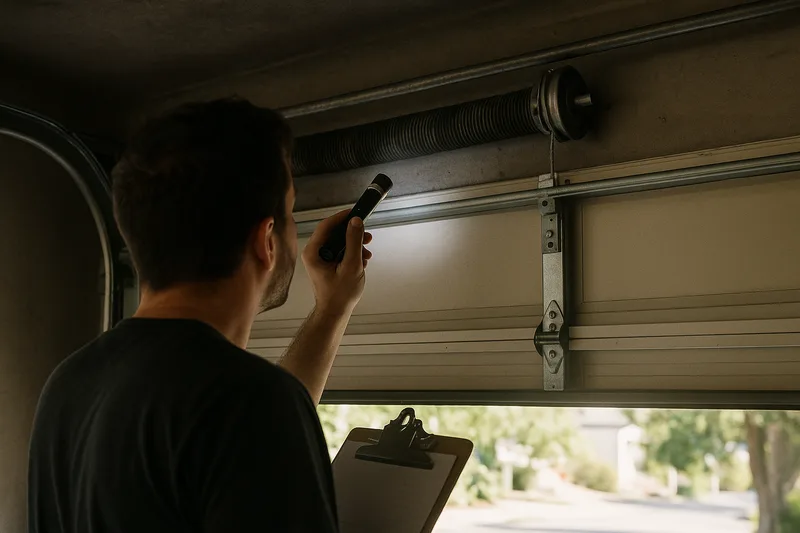
Thorough inspection of springs, cables, and hardware for wear and fatigue
How Much Does Spring & Cable Inspection Cost?
| Service | Price Range |
|---|---|
| Spring & Cable Inspection | $69–$99 |
| Inspection + Counterbalance Test | $89–$129 |
| Inspection + Preventive Lubrication | $99–$139 |
| Emergency Inspection (Same-Day) | $99–$149 |
All inspection services include a written condition report. If we identify components that need spring replacement or cable repair, we provide a separate estimate with no obligation to proceed.
What We Inspect: Springs
Your garage door springs are the hardest-working components in the entire system. They cycle thousands of times per year under hundreds of pounds of tension. Our inspection evaluates every aspect of spring condition to determine remaining lifespan and safety.
Torsion Springs
Torsion springs mount horizontally above the door opening on a metal shaft. They are the most common spring type on residential garage doors in Berkeley. During our torsion spring inspection, we evaluate:
- Surface pitting, scoring, and deformation. These mark the stress points where a fracture starts.
- Rust. Coastal moisture eats into the wire diameter, and a thinner wire carries less load for fewer cycles.
- Cycle count. Standard torsion springs are rated for about 10,000 cycles, roughly 7 to 12 years of typical use. Installation date plus usage pattern tells us how much life is left.
- Coil gaps. Any visible separation between coils means the spring is at or past its failure point.
- Tension, tested with the door at multiple positions. Wrong tension overworks the opener and makes the door unpredictable.
- The mounting hardware: center and end bearing plates, winding cones, set screws, and the torsion shaft, checked for wear, cracks, and loosening.
Extension Springs
Extension springs run along the horizontal tracks on both sides of the door. They stretch to store energy when the door closes and contract to help lift it open. Our extension spring inspection covers:
- The spring's length at rest. Permanent stretch means fatigue, less lifting capacity, and a failure on the way.
- The hooks and clips at each end, checked for straightening, wear, and loose mounting bolts.
- The safety cables. Every extension spring needs one through its center, because a spring that breaks without one becomes a projectile. We verify they're installed, intact, and anchored.
- Tension balance between the two sides, so the door runs level instead of grinding tracks and rollers unevenly.
What We Inspect: Cables
Garage door cables are steel wire ropes that connect the springs to the door, transferring the counterbalance force that makes your heavy door manageable. Cable failure can cause the door to drop suddenly or hang at a dangerous angle. Our cable inspection evaluates:
- Fraying and broken strands, along the cable's full length. Even minor fraying means the cable is compromised and will keep deteriorating.
- Kinks and bird-caging. A kink is a permanent weak point, and strands bulging outward mean the cable's internal structure is already damaged.
- Rust, outside and in. Corrosion between strands is the dangerous kind, invisible from outside while it hollows the cable out.
- How the cable winds on its drum. Overlapping wraps, gaps, or a cable out of its groove cause uneven lifting and can derail the door.
- Equal length and tension between the two cables. Unequal cables hang the door crooked.
- The bottom bracket termination, checked for a stretched attachment loop, bracket cracks, and bolt tightness.
- The safety cables through any extension springs, secured at both ends and undamaged.
How Counterbalance Works
A residential garage door typically weighs between 150 and 400 pounds depending on size and material. Without a counterbalance system, this weight would make the door nearly impossible to open manually and would burn out an electric opener within weeks. The spring and cable system solves this by storing energy when the door closes and releasing it when the door opens.
When your door closes, the springs wind tighter (torsion) or stretch longer (extension), storing potential energy equal to the door's weight. When you activate the opener or lift manually, the springs release that stored energy through the cables, effectively neutralizing the door's weight so it moves with minimal force. A properly balanced door should stay in any position when the opener is disconnected, requiring less than 10 pounds of force to move.
When springs fail, the full weight of the door transfers entirely to the opener motor or to whoever is holding it. A broken spring while the door is up means 200 or more pounds can crash down with no resistance. A broken spring while the door is down means the opener cannot generate enough force to lift it, or it strains the motor to the point of premature failure. This is why spring condition directly affects both safety and opener longevity.
Signs Your Springs or Cables Are Failing
Watch for these warning signs that indicate your springs or cables need professional inspection immediately:
- A visible gap in the torsion spring coils. The spring has already partially failed, and the full break is close.
- The door feels heavier than it used to. The springs are losing tension, and your hands or the opener are picking up the difference.
- Frayed or unraveling cables. Visible strand damage means a cable that can snap without warning.
- A loud metallic bang from the garage. That's usually a spring breaking. Leave the door alone and call for emergency service.
- The door closes too fast. Weak springs can't control the descent anymore.
- One side hangs lower than the other. A weakened spring on one side, or a cable off its drum.
- Rust on the springs. The metal is actively weakening, faster near the coast.
- Cables hanging loose or slack. Something upstream has failed, and the door is unsafe to run until a tech looks at it.
How Long Do Garage Door Springs Last?
Garage door spring lifespan is measured in cycles rather than years. One cycle equals one full open and close. The actual years of service depend on how frequently you use the door.
- Standard torsion springs are rated for 10,000 cycles. At 4 cycles a day, that's roughly 7 to 9 years. These are what most homes have.
- High-cycle torsion springs are rated for 25,000 cycles or more and run 15 to 20 years. They cost more upfront and less per year.
Four things move your springs' actual lifespan:
- Coastal moisture. Homes within a few miles of the water can lose 10 to 20 percent of spring life to corrosion.
- Lubrication. Springs that get annual professional lubrication run cooler and rust slower.
- Usage. A door that cycles 8 times a day spends its cycles twice as fast as one that cycles 4. Heavy users should consider high-cycle springs from the start.
- Wire quality. Oil-tempered wire with consistent diameter outlasts bargain springs, which fail at their manufacturing flaws.
Frequently Asked Questions
How do I know if my garage door spring needs replacing?
Five signs: a visible gap in the torsion spring coils, a door that feels heavy when lifted by hand, a loud bang from the garage (the spring already broke), one side hanging lower than the other, or a spring past 7 years old. Any of these means book an inspection now.
How long do garage door springs last?
About 10,000 cycles for standard torsion springs, which is 7 to 9 years at 4 cycles a day. High-cycle springs rated for 25,000 or more cycles run 15 to 20 years. Coastal humidity, missed lubrication, and heavy daily use all pull those numbers down.
Is it dangerous to have a worn garage door spring?
Yes. A spring holds hundreds of pounds of tension while supporting a 150 to 400 pound door, and a worn one can let go at any point in the cycle. When it does, the door can crash down on whoever or whatever is underneath. Spring repair and adjustment stay professional jobs.
Should I replace both springs at the same time?
Yes. Both springs went in together and have the same cycles on them, so when one fails the other is right behind it. Doing both in one visit heads off a second failure weeks later, keeps the door balanced, and saves the cost of a second service call.
Can I inspect garage door cables myself?
Looking, yes. Touching, no. Check for fraying, kinks, rust spots, or cables hanging loose from a safe distance. The cables are under full spring tension, and one that snaps can cut deep. Hands-on inspection and adjustment stay with a trained tech and the right tools.
Why Choose Santos & Sons
Santos & Sons Garage Door brings years of hands-on experience inspecting and servicing spring and cable systems across Berkeley and the greater Bay Area. Our technicians understand the specific demands that coastal humidity and daily cycling place on these critical components.
We carry common replacement springs and cables on our service trucks, so if your inspection reveals a component that needs immediate attention, we can often complete the spring replacement or cable repair during the same visit without a second trip charge. We also stock high-cycle upgrade springs for homeowners who want extended lifespan between replacements.
And the report tells the truth either way. If your springs and cables are in good shape, that's what it says, along with the date to check again. Plenty of inspections end exactly there. Our name is on every invoice in Berkeley, and that's worth more than an unneeded spring sale.